Capacity Development Manual for Transport Institutions
–
30/11/2026
Themes
Country
Client
The Capacity Development Manual for Transport Institutions was developed to support transport institutions, especially in low- and middle-income countries (LMICs), in institutionally embedding capacity development processes.
Building on the findings of the 2024 High Volume Transport Applied Research (HVT) study, (Capacity Building in Sustainable Urban Mobility for Low-Income Countries: Research on Demand and Success Factors for Future Supply), the manual responds to persistent capacity gaps of transport institutions on the individual, organisational and societal levels. These gaps constrain the ability of transport institutions to deliver and sustain transformative, climate-aligned mobility initiatives. Specifically, the HVT research found that capacity development is often fragmented, short-term and focused on specific capacity development formats such as training, with insufficient attention to institutional systems and long-term learning.
The Capacity Development Manual for Transport Institutions therefore translates global best practice into practical frameworks, tools and actionable steps to address these challenges. Five transport authorities across Africa and South Asia reviewed and pilot tested the manual, helping ensure its relevance to institutional needs and working contexts.
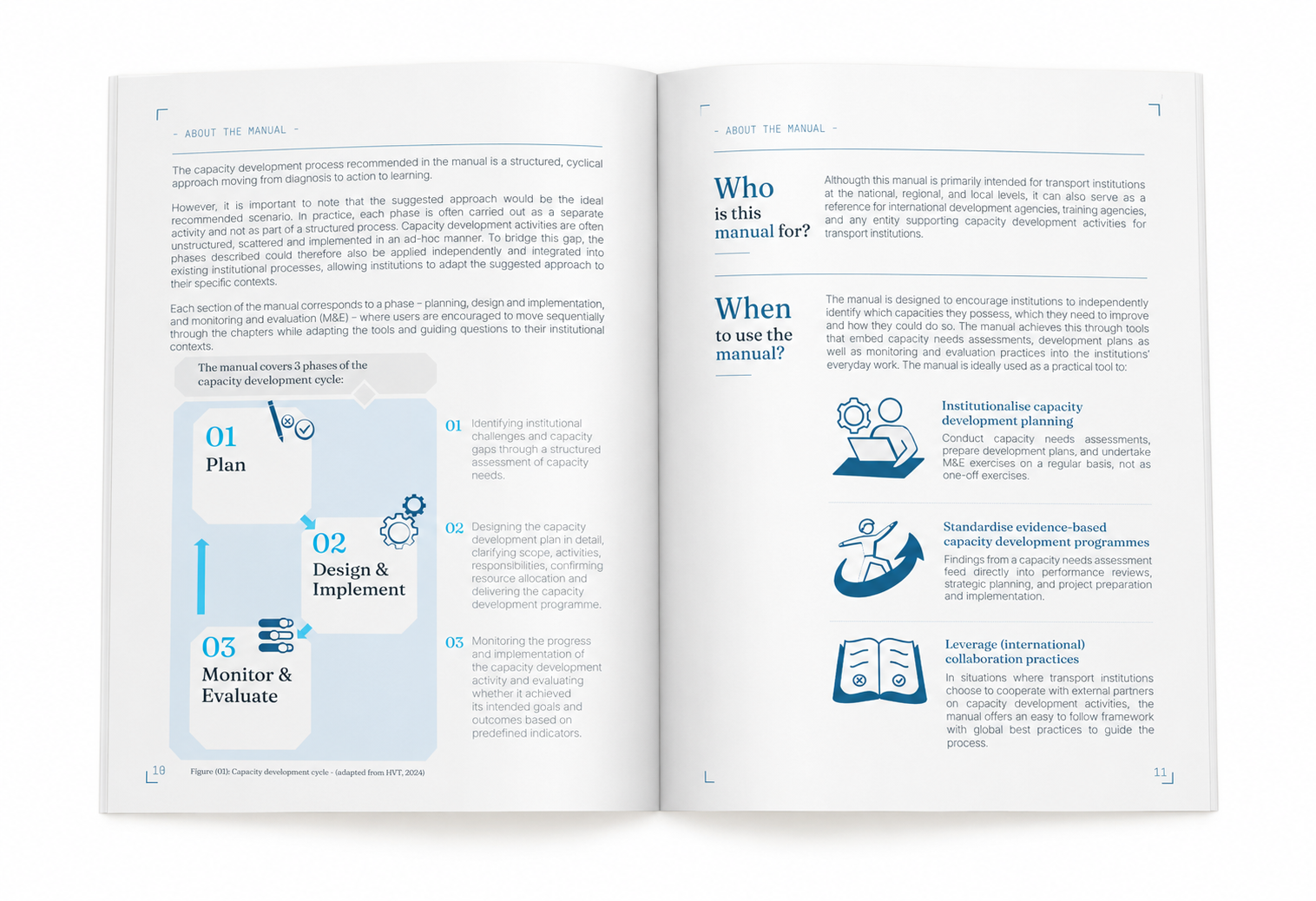
The manual is primarily intended for national, regional and local transport institutions, including transport authorities and operators. It also serves as a reference for international development agencies, training providers and other organisations supporting capacity development in the transport and mobility sector.
The manual is currently available in both English & French.
What the manual covers:
- Phase 01: Plan (Steps 1–7) identifies institutional challenges and capacity gaps through a structured capacity needs assessment and prioritising (learning) objectives .
- Phase 02: Design & Implement (Steps 8–12) translates the identified capacity needs into action by selecting suitable capacity development formats, providers and partners, and defining implementation arrangements, responsibilities and budgets.
- Phase 03: Monitor & Evaluate (Step 13) tracks the progress of the capacity development activity against the pre-identified indicators, assesses outcomes and documents lessons learnt to inform future capacity development activities.
- SWOT analysis
- Workplan & Gantt chart
- RACI matrix
- Task & performance analysis
- Problem tree analysis
- Eisenhower matrix
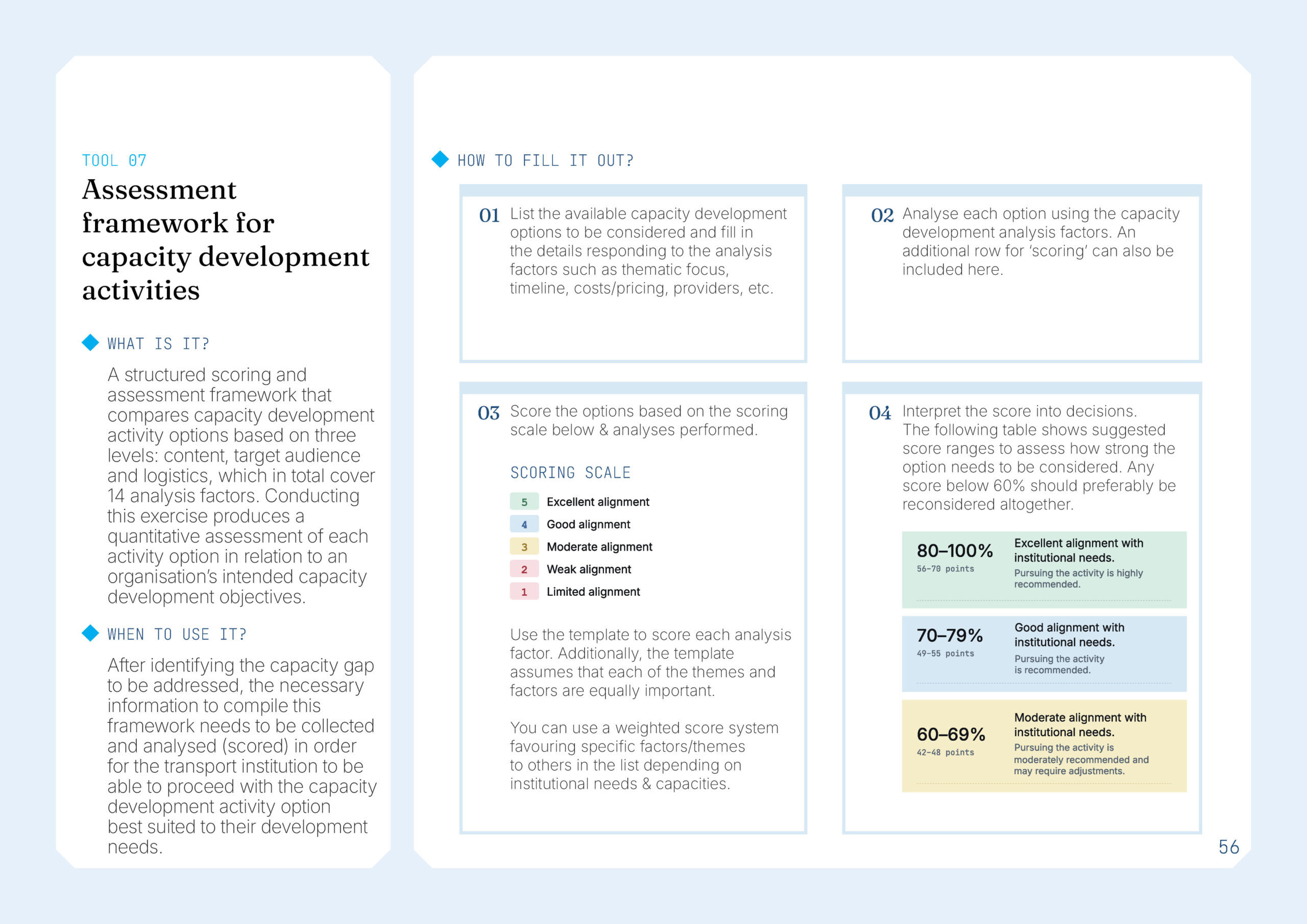
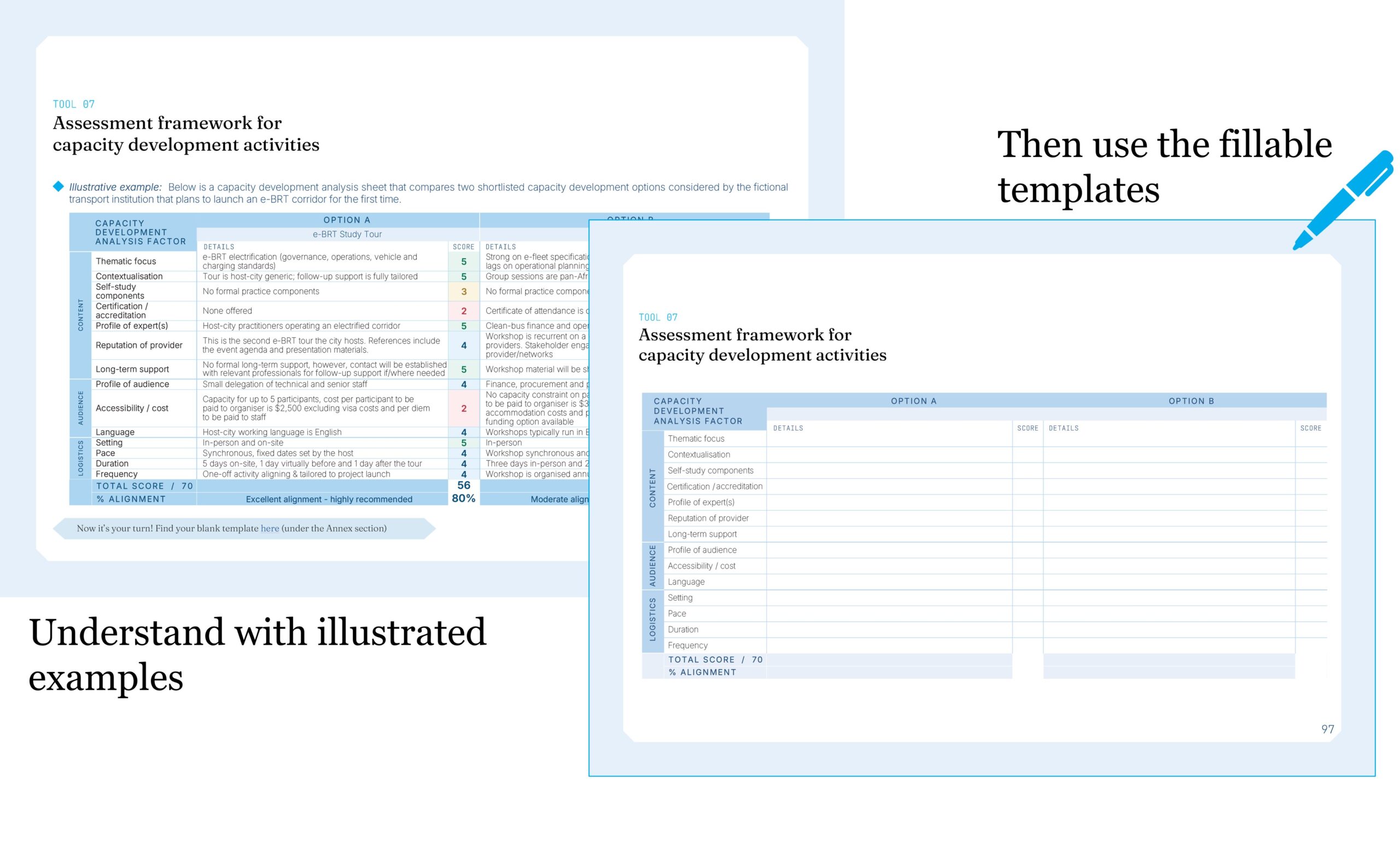
- Assessment framework for capacity development activities
- Scenario building
- Theory of Change
- Operational plan
- RAID matrix (risk matrix)
- Logical framework (Logframe)
- Progress report
Both blank templates (including digital formats) and filled in templates using an illustrative example are provided.